Teft
The Way of KingsTeft is a grizzled Bridge Four veteran whose importance lies in the way he turns endurance into fellowship. He first appears among men reduced to expendable military labor, but his guarded independence, practical care, and fragmentary knowledge of the Knights Radiant make him more than another casualty of the bridge crews. Through his connection with Kaladin Stormblessed, Teft becomes both participant in and witness to the crew’s movement from forced obedience toward chosen solidarity.
Identity and Introduction
Teft is introduced as an older bridgeman who has already spent time in the crew and has previously served on another bridge. His transfer to Bridge Four was itself a punishment for camp infractions, placing him within a system that uses reassignment, labor, and exposure to danger to discipline enslaved men. He is not presented as eager to trust: when Kaladin approaches him, Teft is wary, eating breakfast alone and protecting his food with the humorously defensive remark that the army scarcely feeds enough for one man, much less two.
His first direct exchange with Kaladin establishes both resistance and the possibility of allegiance. Kaladin pressures the silent man until he gives his name, and Teft finally identifies himself. Kaladin then introduces himself as Teft’s bridgeleader, turning a formal position imposed by the army into the beginning of a personal relationship. Teft’s hesitation before taking Kaladin’s hand suggests how unfamiliar genuine regard has become within Bridge Four, where men are commonly treated as replaceable equipment rather than as companions.
Life Within the Bridge Crews
Teft’s circumstances are defined by the brutal logic of bridge duty. Bridgemen who lag during work are whipped, while those who lag during a run or refuse to charge the Parshendi are executed. Other punishments include extra labor, docked pay, and being tied to a post or wall to face a highstorm. The Honor Chasm offers the remaining choice that the bridgemen call honorable: death by their own decision rather than death imposed by the army.
This system makes obedience indistinguishable from suicide. Charging with a bridge may kill a man, but refusing to charge guarantees execution. The chasms therefore become more than geographical fractures in the Shattered Plains: they are the point where military discipline has broken through the body and reached the will. Teft belongs to this population of exhausted men, yet his later conduct shows that the army has not entirely erased his capacity to judge, remember, and care.
The physical discipline imposed on the bridgemen is made visible through the bodies it damages. Kaladin Stormblessed is branded on the forehead, including the fresh Shash mark identifying him as dangerous, and the men are compelled to run until punishment or death ends their resistance. Teft’s place in Bridge Four is consequently shaped by the same machinery of enslavement that surrounds Kaladin: the crew is a controlled labor force, but it is also a gathering of men who still possess the ability to recognize courage in one another.
Loyalty to Kaladin Stormblessed
Teft’s loyalty develops through concrete acts rather than declarations. He is not among the men who laugh when Kaladin is rejected by the crew, and he is quick to help when the injured Leyten must be carried. That earlier assistance distinguishes him from the passive or hostile majority and makes him one of the few men Kaladin can approach when he realizes that Bridge Four needs additional help. Kaladin identifies Teft as someone who has already demonstrated reliability, while Rock’s presence confirms that the emerging alliance is becoming collective rather than merely private.
After Kaladin is left battered and broken, Teft remains beside him. Kaladin has several tender ribs, a likely broken collarbone, and a swollen eye, yet still attempts to think about cleaning the other men’s wounds. Teft answers this self-neglect by insisting that Kaladin drink from the watergourd. The repeated command is simple, but its force comes from its refusal to let Kaladin turn himself into another resource consumed by the bridge system. Teft recognizes that the man who spends every remaining strength on others must first be kept alive himself.
Teft’s support also carries an interpretive burden. He notices that Sylphrena’s memories of Kaladin’s earlier life are strangely incomplete, and that she claims to remember watching him fight before she had supposedly begun following him. This inconsistency unsettles Kaladin and adds uncertainty to the bond forming around him. Teft is not the source of the observation, but his position within the crew places him close to the consequences of Kaladin’s hidden transformation: he is among those who can see that the present man is connected to a past strength that has not fully disappeared.
The Envisagers and the Return of Hope
Teft’s inner conflict becomes explicit when Kaladin survives the highstorm. While taking a watch beside the injured man, Teft wonders why such a figure has appeared now and in this place, after so many people have watched and waited. His thoughts reveal that he once rejected the Envisagers, yet has not escaped the expectations and fears associated with them. He keeps three small diamond spheres saved from his wages, preserved through a long period in which he saved almost nothing, because he has been thinking and worrying about what Kaladin’s arrival might mean.
The spheres are a precise emblem of Teft’s divided position. They are ordinary resources, but he has retained them as possible instruments of revelation, linking material survival to a religious or prophetic hope he does not fully trust. His response is not uncomplicated faith. He has rejected the Envisagers, and his anticipation is described as fear as much as hope. Teft therefore embodies the danger of expecting salvation from a wounded person: he wants Kaladin’s survival to mean something, but he is also afraid of what that meaning would demand.
Witness to Transformation and Narrative Role
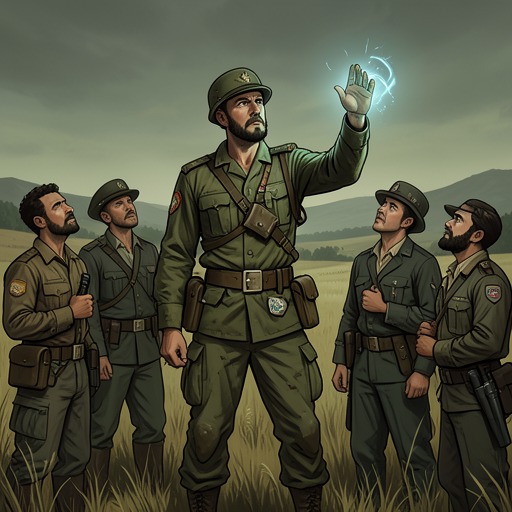
During the battle in which the Alethi struggle to escape, Teft becomes the observer who can measure the scale of Kaladin’s change. Only moments earlier, Kaladin had appeared close to death, with grey skin and shaking hands. Now he stands before the bridge as a shining whirlwind, wielding a spear while white Stormlight streams from him. His speed is nearly inhuman, and each thrust strikes an unarmored part of Parshendi flesh.
Teft understands that Stormlight alone cannot account for what he sees. His incomplete memories of what his family tried to teach him nevertheless agree that Stormlight does not grant a man skill; it enhances, strengthens, and invigorates what is already present. In that distinction, Teft recognizes the moral and personal continuity beneath the miracle. Kaladin has not become someone unrelated to the soldier and protector he once was. The power perfects capacities that hardship had buried but not destroyed.
Teft’s narrative function consequently moves through three positions: punished bridgeman, practical ally, and witnessing interpreter. He knows the crew’s exhaustion from within, answers care with care, and carries a troubled connection to the Envisagers. When he watches Kaladin fight, his astonishment gives the scene a human measure: the transformation is not merely spectacle, but the return of a man whom others had already assumed lost. Through Teft, Bridge Four’s endurance becomes legible as the foundation for belief, fellowship, and the possibility that the broken people of the Shattered Plains may stand for something other than their assigned deaths.